

Internationalization and competition advantage
As a continuous concept, internationalization refers to the degree to which internationalization is deepened along with the progress of product life cycle. The four primary methods of gaining a CA are cost leadership, differentiation, defensive strategies, and strategic alliance (Li and Zhou, 2010). Sandberg (2013) regarded internationalization as an incremental process which is driven by the mutual effect between the acquisition of international business operations and commitment to international markets, demonstrated by gathering specific knowledge related to markets or customers of certain foreign markets. To manage and control international markets, SMEs learn from these markets; thus, they can make quick analysis, segmentation, and interpretation of customers’ actual demands to offer the needed commodities to the customers (Buccieri et al., 2020; Cadogan et al., 2009; Nakos et al., 2019). SMEs can conduct quick integration, spread, analysis, interpretation, and identification of extensive information, and can also absorb improvement suggestions to enhance existing products and marketing approaches for customers and competitors in international markets (Buccieri et al., 2020; Peng and Lin, 2021b). In the context of Taiwan, SMEs play a crucial role in the economy, accounting for 97.65% of enterprises (Ministry of Economic Affairs, 2022). Due to Taiwan’s limited domestic market and resource constraints, SMEs are particularly motivated to internationalize in order to access larger markets and maintain competitiveness (Tsai and Ren, 2019). Taiwanese SMEs, especially those in the manufacturing sector, often rely on ISAs to acquire the knowledge and resources necessary for international expansion, helping them to overcome the inherent challenges of limited scale and resource availability (Liu et al., 2018). There is a growing body of literature on the CA of firms based on the perspective of internationalization, which has gained empirical support, whether from the view of the internationalization of SMEs, the network type of firms, or how the knowledge flow affects CAs (Li and Zhou, 2010; Rui et al., 2017).
Nevertheless, there is little discussion about the sustainability of CAs (Harrigan and Diguardo, 2017), and how CAs are acquired by SMEs during their internationalization (Kwak et al., 2018). CA, management attitude, and foreign knowledge and experience do not substantially connect with internationalization (Weerawardena et al., 2017). Falahat et al. (2020) forecast four necessary export competencies as CA drivers for exporting SMEs: market knowledge, product innovation, price, and marketing communication. According to the findings, a CA only acts as a link between pricing capabilities and SMEs’ international performance. SMEs’ financial and strategic performance may be utilized to evaluate their global performance (Falahat et al., 2018; Popa et al., 2018; Silva et al., 2018). CAs may be used to forecast how well SMEs will do on a global scale (Rua et al., 2018).
Internationalization is quite different in high-tech industries compared to other industries. Most high-tech industries enhance their innovation capability and the ability of product release through international cooperation or M&A, or by offering new products and services which are superior to those in new markets (Anning-Dorson, 2018). This perspective aligns with Aldibiki and El Ebrashi (2023), who emphasize that leveraging networks and capabilities is crucial for SMEs’ internationalization success. Kamepalli et al. (2020) investigated the impact of merger policy on pre-merger innovation, discovering that a liberal merger policy might dampen entrant innovation. To gain an in-depth comprehension of the effectiveness and capability growth of the internationalization of SMEs, it is necessary to incorporate the CAs under internationalization with the institutionalized ones based on past differentiation and cost leadership (Li and Zhou, 2010). Thus, exploring the development of SMEs’ DICs and the relationship between DICs and CA is becoming increasingly crucial in the theory of internationalization, particularly considering the role of network exploration and exploitation capabilities in identifying international opportunities (Faroque et al., 2021).
International strategic alliance
Strategic alliance is essentially a pact of collaboration struck amongst industry contemporaries, targeting the accomplishment of shared objectives. Alliance affiliates adhere to a uniform standard, culminating in a mutual agreement on certain parameters (Christoffersen, 2013; Nielsen and Nielsen, 2009; Robson and Katsikeas, 2005). According to Gulati (1998), SMEs have a tremendous opportunity to develop by combining with other big corporations and building strategic alliances. These are defined as voluntary alliances between businesses based on contractual ties that allow for growth and transformation through collaboration in the production and development of a final product, as well as the transfer of technology, skills, and services. A strategic alliance, in finer detail, encompasses partnerships of interfirm collaboration engineered to influence the enduring product market stance of at least a single participant (Robson and Katsikeas, 2005). Faroque et al. (2021) emphasize the importance of microfoundations in network exploration and exploitation capabilities, which are essential for recognizing international opportunities, thereby enhancing the effectiveness of strategic alliances. Historic examinations of strategic alliances have endeavored to fill myriad research voids from the standpoint of organizational comprehension and knowledge conveyance. This includes aspects such as (1) methodologies for managing knowledge within strategic alliances, (2) tactics for knowledge dissemination among partners, (3) strategies for knowledge acquisition from parent entities by the joint venture, and (4) the evolution and impact of knowledge pertaining to collaboration itself over time (Christoffersen, 2013; Ho and Wang, 2015; Nielsen and Nielsen, 2009; Simonin, 1999). Furthermore, Aldibiki and El Ebrashi (2023) highlight that the role of networks in the internationalization of SMEs is crucial, as these networks can facilitate access to necessary resources and knowledge, enhancing the potential success of strategic alliances. These investigations have unveiled that knowledge cultivation and transfer within an alliance bear immense strategic value in bolstering a firm’s competitive edge (Christoffersen, 2013; Nielsen and Nielsen, 2009).
A growing body of scholarly work has broadened the realm of local strategic alliances to incorporate ISAs, intertwining theories such as resource-oriented views, DC, organizational learning, and corporate internationalization. This convergence has birthed a multidisciplinary research field. Within the framework of technological evolution and globalization, ISAs emphasize more on the stability, expansion, and enduring progression of international business organizations compared to their local counterparts (Robson and Katsikeas, 2005). ISAs can be viewed as a mode of collaboration amongst firms in an international and interconnected environment, harmonizing the firms’ objectives and missions to optimize resource utilization and autonomous management within organizations (Ho and Wang, 2015; Li et al., 2013; Nielsen and Gudergan, 2012).
Robson and Katsikeas (2005) further elucidated that ISAs are foreign investment ventures encapsulating a ceaseless process of commercial activity, underlining the formation issues of intrapartner traits and interpartner compatibility. As such, alliance classifications also diverge based on differing partner characteristics and compatibility modes. Nielsen and Gudergan (2012), borrowing from Lavie and Rosenkopf’s (2006) viewpoint, segmented ISAs into international exploration alliances and international exploitation alliances. They characterized international exploration alliances as ISAs primarily engrossed in upstream value-chain activities aimed at knowledge sharing and development; conversely, international exploitation alliances concentrate on downstream activities such as marketing and distribution. This dichotomy mirrors the classification of Dual Innovation Capabilities (DICs) by ambidexterity, disregarding the requisites of varied alliance characteristics on knowledge attributes, strategic maneuvers, and innovation.
International firms will choose to join one of the ISAs depending on their distinct organizational structures, capabilities, strategies, processes, cultures, and objectives. International exploitation alliances furnish internationalized firms with more exploitation knowledge, thereby enhancing capital and asset productivity and efficiency through standardization, systematic cost reductions, and advancements to existing technologies, skills, and capabilities (Nielsen and Gudergan, 2012). Similarly, international exploration alliances equip internationalized firms with more exploration knowledge, thus aiding in the unearthing of new wealth-creation opportunities and superior returns through innovation, new capabilities, and investments in absorptive capacity (Nielsen and Gudergan, 2012).
Firms participating in international exploration alliances foster a reciprocal learning culture through engagement and interaction with firms from other nations, grounded in a stable and robust cooperative relationship (Ho and Wang, 2015; Christoffersen, 2013; Nielsen and Nielsen, 2009). Such informal agreements allow international firms to access innovative knowledge resources from the alliance network. Concurrently, international firms within the alliance can leverage joint problem-solving, joint new product development, and joint research and development investment projects (Robson and Katsikeas, 2005) to amass internal innovation capabilities (Li et al., 2013). Scholars propose that the superior efficiency of international firms in fostering close strategic relationships (Christoffersen, 2013; Nielsen and Nielsen, 2009) will aid international firms in creating collaborative opportunities with other firms, obtaining the requisite knowledge and information to strengthen their value innovation capability, thereby further enhancing international exploration (Robson and Katsikeas, 2005).
Moreover, strategic relationships within international exploration alliances’ member base will allow international firms to comprehend the operating model of benchmarking firms and knowledge processing, equipping firm members with the skills to identify external knowledge and further correct internal routines, processes, and production efficiency (Li et al., 2013; Nielsen and Gudergan, 2012). The process of external learning that promotes internal learning enables international firms to bolster their fundamental capabilities and viability as a foundation for business growth (Ho and Wang, 2015; Nielsen and Gudergan, 2012). Nielsen and Nielsen (2009) asserted that international interfirm relationships with innovative learning can enhance the understanding of both firms’ tacit knowledge, improve their inadequacies in knowledge application, strengthen the link between relationships and knowledge, and further improve the ability to apply innovation. Thus, the study forms the following hypotheses:
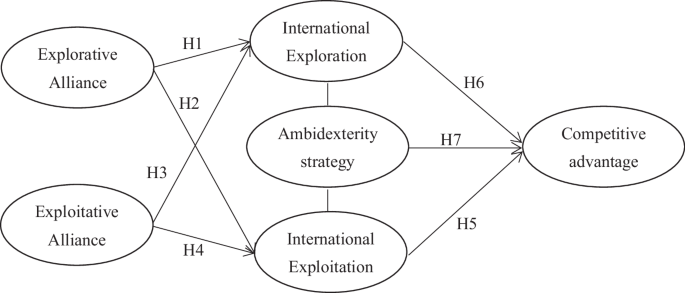
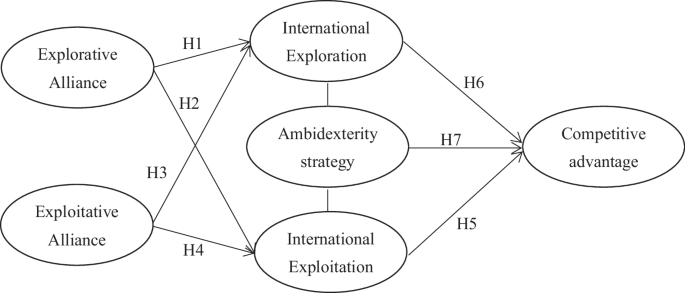
H1: International explorative alliance has a positive impact on international exploration.
H2: International explorative alliance has a positive impact on international exploitation.
The knowledge-based perspective views firms as storehouses of knowledge and competencies, while the learning-based perspective emphasizes the acquisition of knowledge that stimulates the development of firm-specific capabilities. Both the knowledge-based theory and the organizational learning theory acknowledge that the nature of knowledge can influence the ease or difficulty of learning and knowledge transfer. Inkpen (2002) identifies five antecedents in alliance learning: (1) learning partner characteristics, (2) teaching partner characteristics, (3) knowledge characteristics, (4) relationship factors, and (5) alliance establishment. He suggests work that incorporates these diverse categories and establishes causal links across variables (Ho and Wang, 2015).
International firms participating in international exploitation alliances are committed to learning and absorbing explicit knowledge that can immediately enhance their internal operational processes. Compared to their counterparts in international exploration alliances, firms in exploitation alliances pay greater attention to diversified relationship connections, such as structural holes and weak ties, as proposed by scholars. During the process of knowledge transfer or learning, international firms also learn how to create value through knowledge while amassing knowledge assets (Christoffersen, 2013; Nielsen and Gudergan, 2012; Nielsen and Nielsen, 2009). For one, international firms learn about the needs of customers in the international market and competitor information from external knowledge sources to provide more efficient products and services. Furthermore, international firms absorb more diverse sources of knowledge from alliances, which aids them in enhancing related innovation activities and capabilities, ultimately improving the development of new products or processes. Based on this understanding, this study formulates the following hypotheses:
H3: International exploitative alliance has a positive impact on international exploration.
H4: International exploitative alliance has a positive impact on international exploitation.
Dynamic internationalization capabilities (DICs)
According to the DC viewpoint, firms must continually produce, integrate, and reconfigure their skills and capabilities to adapt to their environment and sustain CA (Eisenhardt and Martin, 2000). The essential traits in DC are exploration and exploitation, and innovation (Atuahene-Gima, 2005). Exploitation focuses on improving present capabilities, whereas exploration focuses on testing existing notions (e.g., March, 1991).
Teece et al. (1997) extended the resource-based view to a dynamic environment through enabling firms to create higher value by developing new knowledge and resources (Peng et al., 2019a, 2019b), suggesting that firms should be constantly updating and reconfiguring their resources and capabilities to address environmental changes. In their study of the impact of DC on the internationalization of SMEs, Mudalige et al. (2019) discovered that owner-specific DCs have a positive influence on both firm DC and internationalization, and firm DCs have a positive influence on internationalization. The development of DCs facilitates firms to consolidate, understand, and reconfigure their internal and external resources in response to dynamic environmental changes in their domestic markets (Peng et al., 2019a, 2019b; Zhou et al., 2020). While enterprises have entered the internationalization process through large-scale expansion, the complexity of the international environment is far higher than that of domestic ones. In order to adapt to the changes in international environments, enterprises need to adopt different operational strategies according to their respective needs so as to increase their ability to learn and reconfigure (Day, 2011; Zhou et al., 2020). Therefore, we can enable these strategies to create greater efficiency. At the same time, a firm can use internal resources to centralize these resources and capabilities, thereby enhancing its performance. Both adaptation to environment and learning are prerequisites for the long-term survival of organizations, so organizations need to improve their current knowledge and strive to acquire new knowledge to expand new markets (Limaj and Bernroider, 2019; Aldibiki and El Ebrashi, 2023). Scholars also argued that DICs can enhance capabilities and broaden resources, thus affecting the performance of firms (Helfat and Raubitschek, 2018).
Limaj and Bernroider (2019) contended that firms increase their exploration and exploitation in different manners. Scholars conducted a dual study of exploration and exploitation earlier, driving firms to develop capabilities while performing varied, competitive behaviors based on their capabilities (Peng and Lin, 2021b; Zhou et al., 2020). The likelihood of success in new markets can be increased through updating and integrating existing capabilities and developing new capabilities. In order to gain success, organizations not only need to value the contents of knowledge and the way of learning, but also make clear that the time it takes to increase the CA and improve performance of organizations by utilizing new or exploratory information and resources (Limaj and Bernroider, 2019). Current knowledge primarily considers international exploitation as the driver for internationalization, and it is believed that the international exploitation can be enhanced by adjusting resource allocation and learning locally available information (Limaj and Bernroider, 2019; Vrontis et al., 2017); international exploration, on the other hand, involves innovation, flexibility, and discovery (Limaj and Bernroider, 2019). Firms create new capabilities for new markets, constantly explore new technologies and new product development based on new customer needs, acquire totally new management capabilities, and recombine internal and external resources, thus allowing enterprises to expand prior knowledge and enhance new value. With the expansion of new markets in the process of internationalization, new knowledge and resources are tapped and acquired through its relationships with local partners in order to create new capabilities, achieve potential advantages a better long-term performance (Vrontis et al., 2017; Faroque et al., 2021), and enhance the adaptability to market changes.
Replacing internal resources and learning management knowledge can greatly improve the performance of firms (Peng et al., 2019a; Vrontis et al., 2017; Zhou et al., 2020). While some scholars believe that DICs have a positive correlation with performance (Stadler et al., 2013), other studies have found negative or no significant correlations (Schilke, 2014). Empirical evidence is still not very clear. Firms’ DICs also vary with internationalization strategies, and the factors required to develop those competencies to facilitate the achievements in the context of internationalization are yet not discovered (Gassmann and Keupp, 2007).
Teece et al. (1997) indicated that the development of exploitation enables firms to acquire new capabilities and resources, adjust internal resources for improvement in business efficiency, and find and capitalize on opportunities. International exploitation is the driving force for firms’ value creation. Acquiring external knowledge and transforming it into internally recognized knowledge is the primary mission of international exploration (Limaj and Bernroider, 2019; Pinho and Prange, 2016). The quality and value of knowledge are items that must be subject to verification in the model of input-process-output. Therefore, internationalized SMEs with better international exploitation will be able to integrate knowledge and technology to facilitate new product development that addresses foreign customers’ needs. When firms introduce this knowledge during knowledge creation and integration of internal knowledge, they are able to create new knowledge with more values than competitors (Prange and Verdier, 2011), thereby enhancing their own market growth and profitability (Peng and Lin, 2021b). Morgan et al. (2009) also argued that enhancing their existing capabilities through exploitation can support firms to satisfy consumer wants and needs and create CAs in new markets while developing their ability to integrate resources and create market values required to achieve outstanding performance (Bicen et al., 2021). Based on the above, this study makes a hypothesis as follows:
H5: International exploitation has a positive impact on competitive advantage.
Organizational learning needs new capabilities and new values to assist in integration after entering new international markets. Moreover, firms’ internationalization process is a type of organizational learning. In the international market, the information and knowledge need to be integrated with the international exploration, so that internationalized SMEs can have a clear strategic position and confirm the needs of global customers, thus expanding market shares and profitability (Peng and Lin, 2021b). International exploration of this advantage empowers firms to develop new capabilities, increase business resilience, exploit new technologies, obtain new managerial capabilities, and discover internal and external resources (Mikalef and Pateli, 2017) so that organizations can maintain a long-term CA in response to market conditions by extending their prior knowledge and building new values (Limaj and Bernroider, 2019). This implies that internationalized SMEs with a high degree of international exploitation are competent to replace internal knowledge based on variations in the external environment and gain strategic dominance with specific strategic behaviors. In addition, scholars have indicated that international exploitation can promote firms’ innovative behaviors and accelerate their knowledge creation (Peng and Lin, 2021a, 2021b), thereby gaining a competitive edge (Limaj and Bernroider, 2019). Furthermore, international exploration results in disruptive innovations (Vrontis et al., 2017), enabling firms to have greater flexibility and innovative energy infusions to maintain a long-term performance excellence (Li, Ye, Sheu, and Yang, 2018). Gerschewski et al. (2018) and Khan and Lew (2018) also studied the internationalization behavior of international new ventures (INVs) and proposed that INVs should gain knowledge in the international market through constant learning to overcome the liabilities of newness and foreignness in their internationalization progression and post-entry survival (Spyropoulou et al., 2018). In the internationalized SME context, international exploration is seen as critical for CA relative to large enterprises in explaining foreign customer value, and positively correlates with performance (Limaj and Bernroider, 2019; Peng and Lin, 2021a, 2021b). Thus, this study makes a hypothesis as follows:
H6: International exploration has a positive impact on competitive advantage.
International exploration and exploitation are critical driving factors for enhancing knowledge integration and creation. International exploitation can increase the reliability and productivity of knowledge, whereas international exploration can strengthen organizational capabilities to integrate new/external knowledge into the internal knowledge base, thereby enabling internationalized SMEs to respond to competitors’ behaviors (Koryak et al., 2018). Competency exploration is described as “experimentation with innovative possibilities with uncertain, distant, and usually negative returns” (March, 1991), and it comprises risk-taking and exploring. However, there is still a lack of understanding on the joint effect of international exploration and exploitation. This study therefore discusses the concept of ambidexterity.
The notion of ambidexterity, proffered by intellectuals, has been espoused in vast measures by diverse institutions and managerial investigations to delve into the ramifications of bifurcated competencies or undertakings on corporate efficacy (Gibson and Birkinshaw, 2004; Koryak et al., 2018; Peng and Lin, 2021b; Peng et al., 2019a, 2019b; Zhou et al., 2021). Instances of these dualities incorporate transformative vs. incremental ingenuity, transmutative leadership juxtaposed against the transformational variant, and exploration-oriented versus exploitation-centric capabilities among others (Peng et al., 2019a, 2019b; Peng and Lin, 2019). Nevertheless, institutions employing an ambidextrous strategy execute examinations and accompanying processes with alacrity and adaptability, aiming to introduce novel commodities or provisions into the international marketplace (Peng and Lin, 2019; Vahlne and Jonsson, 2017).
The ambidexterity arising from international exploration and exploitation contributes to making internationalized SMEs focus concurrently on the advancement of knowledge acquisition and knowledge creation, as well as reducing the allocation risk of overemphasizing international exploration and exploitation (Broersma et al., 2016; Heavey et al., 2015; Luca et al., 2019; Vahlne and Jonsson, 2017). In addition, some scholars (Peng and Lin, 2021a; Peng et al., 2019a, 2019b) have claimed that ambidexterity is a structural mode, which promotes the establishment of various organizational structures by firms to participate in activities with contradictions and opposites via differentiation strategy. In the context of internationalization, Peng and Lin (2021b) argued that when there is a strong complementary effect between international exploration and international exploitation, it is beneficial for international enterprises to cultivate adaptability between different capabilities, which will be reflected in the subsequent international performance. For instance, in a highly variable environment, resources invested in international exploitation can be transferred to international exploration in pursuit of performance maximization: in other words, CA is improved. By simultaneously adopting international exploration and exploitation, and thus utilizing the existing knowledge and resources, internationalized SMEs can more easily explore related knowledge or resources and learn about the situation in a more thorough way (Rafailidis et al., 2017). Thus, more effective reconfiguration of current knowledge/resources is achieved while promoting international exploration and exploitation to leverage existing strengths and deal with risk to inspire market opportunities in the future (Spyropoulou et al., 2018). Therefore, this study proposes the following hypothesis:
H7: Ambidexterity of international exploitation and exploration has a positive impact on competitive advantage.
To elucidate the relationship between International Exploration and Competitive Advantage, it is imperative to acknowledge that exploration activities serve as a foundational element for firms aspiring to navigate and thrive in dynamic international markets (Zhang and Chen, 2013). Through international exploration, firms gain critical insights into emerging market trends, consumer preferences, and competitive dynamics, all essential for adapting strategies to meet evolving demands (Buccieri et al., 2020). However, the act of exploration does not inherently secure CA; the capability to leverage the insights garnered is equally paramount (Cadogan et al., 2009).
In this context, International Exploitation assumes a pivotal role. Exploitation encompasses applying newly acquired knowledge and resources to enhance existing capabilities and operational efficiencies (Helfat and Peteraf, 2003). For SMEs, particularly within the Taiwanese landscape, the transition from exploration to exploitation is crucial for converting innovative concepts into viable products and services (Al-Hakimi et al., 2023). Operating within a resource-constrained environment, Taiwanese SMEs must strategically manage this transition, ensuring that the knowledge acquired through exploration is adapted to local market conditions and effectively utilized to refine offerings while responding to competitive pressures (Nielsen and Gudergan, 2012; Li et al., 2013).
Consequently, while international exploration establishes the groundwork for potential CA, it is international exploitation that ultimately mediates this relationship (Zhang and Chen, 2013). Effective exploitation enables firms to harness exploratory insights, transforming knowledge into actionable strategies that drive performance and foster competitive differentiation (Broersma et al., 2016). Thus, comprehending the mediating role of international exploitation is essential, as it underscores the necessity of gathering information through exploration and systematically mobilizing it to achieve sustained CAs in the global marketplace (Peng and Lin, 2021b). In conclusion, the interplay between exploration and exploitation emphasizes a dynamic capability framework vital for the success of SMEs in international contexts (Al-Hattami and Kabra, 2022; Heavey et al., 2015).
H8: Hypothesis: international exploitation mediates the relationship between international exploration and competitive advantage in Taiwanese SMEs.
Based on the above hypotheses, this study presents a research framework as shown in Fig. 1.
link