

Adapting agricultural production to climate change and environmental sustainability
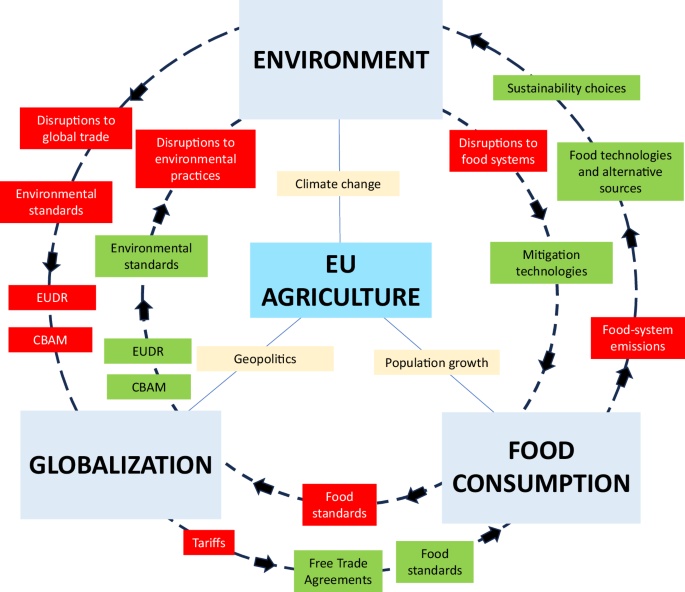
EU agriculture faces a complex global challenge at the nexus of climate change, production dynamics, and environmental sustainability. Climate change escalates the risks for agricultural productivity and food security. At the global level, severe climate change without adaptation can reduce crop yields from 7% to 23%3,7. In addition to changing average temperature and precipitation patterns, an increased frequency and intensity of extreme weather events like droughts, heatwaves, and floods significantly amplify risks to EU agricultural production8,9. Moreover, EU agricultural production is also affected by concurrent and combined hazards from climate change, such as outbreaks of invasive alien species and newly adapted pests and diseases10,11.
The impacts of climate change on the EU are heterogeneous, showing a north-south divide and a progressive northward shift in agro-climatic zones1,12. This shift might generally benefit northern European regions through higher temperatures, prolonged growing seasons, and potentially higher yields. Conversely, southern EU regions, especially in the Mediterranean, are to experience decreased crop suitability and are seriously threatened by desertification13,14,15. Moreover, despite elevated CO2 levels may favor the productivity of some crops such as wheat and rice, the response in plant biomass production may be limited or offset by factors such as nutrients and water availability, and extreme events7,16.
For EU livestock production, climate change directly affects animal health and reproduction, but it also influences the quantity and quality of feed and water17,18. This may require potential increases in the purchase of additional feed (including imports), thereby leading to higher input costs for farmers and eventually to higher dependency from imports and international market variability. In addition, heat exposure, in combination with extreme humidity levels, is among the most challenging extreme weather conditions for EU dairy production, resulting in increased cow mortality rates, reduced milk quantity, and lower protein content19.
The whole picture is further complicated by the fact that agricultural activities themselves contribute to climate change through greenhouse gas (GHG) emissions and can contribute to broader environmental degradation. Globally, the agriculture, forestry and other land use (AFOLU) sector accounts for 22% of net global GHG emissions1. In a broader context, food-system emissions represent about 34% of total GHG emissions20. Therefore, effective mitigation strategies are not only necessary for reducing the production risks of climate change but also to reduce emissions and promote carbon sequestration in the EU21,22.
Technological and management measures and practices are central for addressing climate change adaptation and mitigation in the EU agricultural sector. Some of these measures and practices are already available to EU farmers, enabling them to cope with moderate climatic events, such as drought-tolerant crop varieties, water management23,24, ecological intensification practices (e.g. increasing crop diversity, adding fertility crops in rotations and organic matter), and changes in livestock feed ration or use of ventilation systems19. However, these measures may prove insufficient during extreme climatic changes, and more advanced technologies are needed to enhance mitigation in the EU. Precision and data-driven technologies offer the potential for real-time, site-specific decision-making, leveraging tools like artificial intelligence (AI), the internet of things (IoT), sensors, drones, robotics, and cloud computing. These technologies can contribute to the development of farmers’ decision support software or digital agronomy services platforms25. New Genomic Techniques (NGTs) hold promise in accelerating the development of improved crop varieties, reducing the timeline from several years to a few months with traits that can support mitigation, increased yields, or reduced natural resources use. However, while technically NGTs allow a much faster development of new varieties, regulations might significantly delay their integration into EU markets for farmers’ use. The yet uncertain EU regulatory approach to NGTs have limited seed breeding companies from investing in these technologies26. Moreover, the EU approval process for marketing and cultivation remains protracted, ranging from 8 to 12 years, depending on the crop’s characteristics, environmental impact, and safety for human and animal consumption27.
The EU adaptation to emerging invasive plants, pests and diseases might also find its own challenges. In recent years, the registration of many plant protection products has expired and not been renewed due to their harmful effects on biodiversity and non-target organisms28. This is the case of neonicotinoid and organophosphate insecticides, non-selective herbicides, and broad-spectrum fungicides (e.g. mancozeb, thiram, and propineb). While their removal from the EU market has environmental benefits, viable alternatives are not yet available to EU farmers. International agro-chemical companies are investing in the development of biocontrol agents and biostimulants. New product launches are expected over the next decade, but for EU farmers to be able to use them, the EU regulatory landscape should evolve accordingly 29.
Evolving consumption and food security
Population growth puts pressure on global food demand, but in the EU, it is the changing age structure of the population that especially influences eating behaviors and household food preferences30. There exists considerable heterogeneity in consumer preferences across EU Member States, due to cultural, geographical, and historical factors, with diets constantly evolving. Consumers in northwestern countries actively advocate for a more sustainable agri-food system and view reduced meat consumption as an integral part of a healthy diet. Conversely, these attitudes are less common in the Eastern and Southern EU regions31. Overall, drivers of change, such as changing lifestyles, health and environmental awareness, evolving eating habits, and the search for new culinary experiences, will generate new business opportunities, but also challenges for both producers and consumers4.
Health and ethical considerations (e.g. animal welfare), along with the environmental footprint of sustained animal production, are partially driving dietary shifts from animal to plant-based food in the EU30. The global market for plant-based protein products is projected to grow by 8% between 2024 to 203032. A global shift towards more plant-based diets has the potential to reduce land use for agriculture by up to 75%33. Moreover, an increased uptake of plant-based diets is associated with better health, enhanced air quality, reduced premature mortality, and substantial reductions in GHG and ammonia emissions34.
The increasing demand for plant-based products observed over recent years signals a gradual yet persistent shift from omnivorous to ‘flexitarian’ diets, i.e. a growing substitution of animal products with plant-based alternatives. Flexitarians, about 30% of EU consumers in 20212, outnumber vegans and vegetarians (a combined 7% of consumers, based on selected EU countries) and thus are more likely to drive the increased demand for plant-based foods than a complete dietary shift towards veganism2. The EU populations of all livestock species have declined over the decade 2013-2023, with goats experiencing the sharpest decline of 15%, followed by sheep (9%), pigs (6%) and bovines (5%)35. A further reduction of the EU livestock population and production is expected to continue also in the medium term, due to the lower demand for animal products, in combination with stricter environmental regulations and more efficient feed conversion ratios (which are likely to be improved via genetics and better-targeted feeding systems)2. However, there are substitution effects between different meat types. For instance, red meat intake (particularly beef and pork), associated with higher social and environmental concerns, is likely to be replaced by poultry meat2.
To address sustainability and animal welfare concerns of EU consumers, new companies and start-ups are exploring synthetic food production methods through biotechnological processes (e.g. cell cultured meat, precision fermentation). Research shows that food produced via biotechnologies can substantially reduce GHG emissions and alleviate land use pressures, but consumer acceptance and willingness to pay for these products are limited36.
Beyond sustainability concerns, EU consumers increasingly demand high-quality, nutritious food. This trend is driving the supply of functional and fortified products, especially in the dairy sector, moving along with demographic changes (e.g. aging populations, athletes, pregnant women)2.
The globalized food system: interdependencies and risks
Addressing the EU’s needs of food affordability and nutrition will require not only increased productivity but also a well-functioning trade system. Globalization presents three main challenges to EU agriculture: (i) maintaining competitiveness amidst increasingly interconnected global markets; (ii) contributing to global food security in a changing geopolitical landscape; and (iii) fostering resilience in anticipation of potential EU enlargement with competitive agrifood producers.
Within the EU, the Single Market facilitates diverse supply chains from various agro- and pedo-climatic zones across Europe, safeguarding the food security of the EU population, contributing to global food security and mitigating risks associated with regional production disruptions37. In 2022, extra-EU trade in agricultural products accounted for approximately 8% of the extra-EU’s overall trade (EUROSTAT figures available here), with net exports of commodities such as wheat, dairy and pig meat to many import-dependent developing countries, alongside high value food products (e.g. wine and cheese with geographical indication). The EU is one of the main driving forces of global openness and integration, and the importance of trade in agricultural products is reflected in its numerous bilateral and multilateral trade agreements signed or under negotiations (see Fig. 2). Further growth opportunities are pursued through an ambitious EU agenda of bilateral trade liberalisation, with ongoing negotiations with Australia, India, Indonesia, Mercosur, Malaysia, the Philippines, and Thailand, among others (see Fig. 3). Dairy products, pig meat and processed agricultural products, including wine and beverages, will be those sectors benefitting the most from these agreements. However, other commodities, such as beef, poultry meat, sheep meat, sugar, and rice, show the highest sensitivity to trade liberalisation, potentially leading to increased imports37. This will be particularly the case if an FTA with some of the most competitive partners like Mercosur is eventually ratified. However, the majority of currently available empirical studies on future EU FTAs do not yet assess the full impacts of policies such as the European Green Deal and the EUDR, not accounting for the short run economic costs and the expected environmental and social benefits of these policies.

The figure is the authors’ own elaboration based on https://policy.trade.ec.europa.eu/eu-trade-relationships-country-and-region/negotiations-and-agreements_en.

Simulations include EU FTAs with Australia, Chile, India, Indonesia, Malaysia, Mercosur, Mexico, New Zealand, the Philippines, Thailand. Trade balance is calculated as the difference between the value of exports and the value of imports. Exports and imports are measured as percentage change (left axis) while change in trade balance in million Euros (right axis) after FTAs awaiting application, concluded but not signed and under negotiation entered into force. The figure is the authors’ own elaboration based on 37.
While the EU is largely self-sufficient in agricultural products, it is dependent on import markets for key agricultural inputs such as feeds and fertilizers38. The EU livestock sector is historically dependent on imports of soybeans from Argentina, Brazil and the United States for protein-rich feed. In addition, recent events have highlighted vulnerabilities in the supply chain of mineral fertilizers whose production is concentrated in a few countries, including Russia and Belarus. Fertiliser prices are closely linked to energy prices, as especially natural gas is the main input to produce mineral nitrogen fertilizer. In 2021, various factors, such as import sanctions on Belarus and Russia, economic recovery from the COVID-19 pandemic, soaring energy prices (which led some fertilizer companies reducing their production), rising fertilizer demand and sudden policies restricting fertilizer exports (e.g. in China), led to a rapid escalation in fertilizer prices39. This prompted challenges for farmers, with many being forced to reduce fertilizer use, resulting in adverse effects on crop yields. To reduce import dependency, the EU has developed an “Open Strategic Autonomy”40 which facilitates free trade, more diversified global value chains, and promotes the domestic production of strategic raw materials or commodities (e.g. protein crops) to reduce the EU’s reliance on imports.
Finally, the landscape of EU agricultural production, international trade, and contribution to the global agri-food market could undergo a significant change with the 2023 Enlargement Package to Moldova, Georgia, Bosnia and Herzegovina, and particularly Ukraine41. Ukraine, with its 41.3 million hectares of agricultural land (which is almost twice the agricultural land of Spain), of which 68% are the highly fertile black soils (chornozem), presents substantial opportunities and challenges. The enlargement would require certain adjustments to existing policies, including the EU’s CAP, as experienced in previous enlargements.
link