


This guide will walk you through what an eCommerce customer acquisition company is, how they work, and how you can benefit from using them.
An eCommerce customer acquisition company is a company that specializes in helping eCommerce businesses attract and acquire new customers.
These companies typically provide a range of services, such as digital marketing, search engine optimization, social media advertising, and email marketing, to help mobile businesses increase their online visibility and drive traffic to their apps and websites.
The goal is to convert users into paying customers and to create a loyal customer base that will continue to purchase from your business over time.
What is customer acquisition in eCommerce?
Customer acquisition in eCommerce refers to the process of attracting and converting new customers to an online store.
This involves using various marketing strategies to drive traffic to the website, such as search engine optimization (SEO), pay-per-click (PPC) advertising, social media marketing, email marketing, and other promotional tactics.
The ultimate goal of customer acquisition is to increase the number of mobile users and revenue for your business.
With the increasing use of mobile devices for online shopping, it’s important for eCommerce businesses to take a mobile-first approach to user acquisition and optimize their marketing efforts accordingly.
Successful customer acquisition improves user engagement and drives revenue. You can find the best eCommerce customer acquisition platforms below.
The best eCommerce customer acquisition companies
eCommerce customer acquisition companies help online businesses attract new customers through a range of marketing, advertising, and data-driven strategies.
These firms specialise in channels such as paid ads (Google, Facebook, TikTok), influencer marketing, SEO, email marketing, and conversion optimisation to drive traffic and turn visitors into buyers.
Many of these companies also offer end-to-end services, from brand strategy and creative content to funnel design and retargeting campaigns. Their goal is to help eCommerce brands grow sustainably by finding the right audience, engaging them effectively, and converting them into loyal customers.
We’ve listed the best eCommerce customer acquisition companies below.
1. Moburst

Moburst is a mobile-first digital marketing agency that helps companies grow through creative and data-driven strategies.
Initially focused on mobile app marketing, the agency has evolved into a full-service digital marketing firm, offering solutions such as user acquisition, app store optimisation, influencer marketing, and digital strategy across various platforms.
The company works with both startups and large global brands, using a mix of performance marketing, creative content, and advanced analytics to drive growth.
Overview
Moburst is a digital marketing agency founded in 2013 by Gilad Bechar and Lior Eldan. It began as a mobile-first marketing company, specialising in app promotion, user acquisition, and app store optimisation.
The company is known for its data-driven approach and creative execution, helping both startups and global brands scale their digital presence. With offices in cities like New York, Tel Aviv, and London, Moburst has worked with major clients across industries and earned recognition for its effectiveness in driving mobile growth and user engagement.
Services
Moburst provides its customers with the following services:
- Performance marketing campaigns using paid media to drive targeted traffic and acquire new customers
- Data-driven audience targeting and segmentation to optimise acquisition efficiency and ROI
- Conversion funnel optimisation to turn traffic into loyal, paying customers through testing and analytics
2. Yodel Mobile

Yodel Mobile is a mobile app marketing and growth consultancy that specialises in helping app businesses scale through a full-funnel, data-driven approach that includes everything from user acquisition and retention to app store optimisation and performance analytics.
Their services are designed to support the entire app lifecycle, making them a strategic partner for both early-stage startups and established brands looking to expand their mobile presence. The agency also offers solutions such as paid user acquisition, conversion rate optimisation, and creative asset development.
Overview
Yodel Mobile was founded in 2007 by Mick Rigby, who also serves as the company’s CEO. He established the agency to help businesses grow in the emerging mobile ecosystem by focusing on user acquisition, engagement, and long-term app success.
Under Mick Rigby’s leadership, Yodel Mobile positioned itself early as a specialist in mobile marketing, long before apps became mainstream. His vision was to offer strategic, full-lifecycle marketing support.
Services
Yodel Mobile provides its customers with the following services:
- Paid user acquisition campaigns across major platforms to drive high-quality app installs
- App store optimisation to improve app visibility and conversion rates in app stores
- Focused on retention, funnel optimisation, and long-term user engagement
3. Perform[cb]

Perform[cb] is a performance marketing company that focuses on outcome-based customer acquisition. The company specialises in helping brands grow by delivering measurable results—such as app installs, sales, or leads—using a cost-per-action model where clients only pay for successful outcomes.
Using AI-driven tools and a wide network of affiliates and media partners, Perform runs highly targeted campaigns across digital channels. Their services include media buying, affiliate program management, and conversion optimisation, all aimed at scaling customer acquisition efficiently and at scale.
Overview
Perform[cb], founded initially as Clickbooth in 2002, is a performance marketing company focused on outcome-based customer acquisition. It was established by John Lemp, who envisioned creating a platform that allowed businesses to grow through measurable, results-driven advertising.
Under Lemp’s leadership, the company became known for pioneering cost-per-action (CPA) marketing strategies, where clients only pay for actual outcomes like leads, installs, or sales. This approach positioned Perform[cb] as a major player in the performance marketing space.
Services
Perform[cb] provides its customers with the following services:
- Designs and manages cost-per-action campaigns to acquire customers efficiently
- Leverages data to target high-intent audiences across multiple channels
- Connects brands with vetted affiliate partners to drive quality customer acquisition
4. Creative Clicks

Creative Clicks is a global performance marketing company that helps brands acquire customers through measurable, outcome-focused campaigns. The company operates in multiple international markets.
Creative Clicks specialises in mobile and digital customer acquisition, using machine learning and big data to optimise campaign performance in real time and focuses on results such as app installs, leads, and sales, delivering campaigns through a wide range of channels, including native, social, display, and video.
With in-house creative production and deep analytics capabilities, the company supports brands in achieving growth while maintaining transparency and efficiency across their marketing funnel.
Overview
Creative Clicks was founded in 2009 by Raymond Kokken and Ramon van den Bulk. The company emerged with a clear vision to create a performance marketing platform that could help businesses acquire customers quickly and at scale.
With Raymond leading as CEO and Ramon as COO, they combined their expertise to build a data-driven marketing agency that quickly grew into a global operation.
From its headquarters in Amsterdam, Creative Clicks expanded into key international markets with offices in cities like London, Tel Aviv, San Francisco, and Toronto.
Services
Creative Clicks provides its customers with the following services:
- Executes performance-based customer acquisition campaigns across mobile, web, and app
- Uses machine learning and big data to optimise targeting, bidding, and user engagement
- Offers in-house creative development, including ad design and video production
5. ASTRAD

ASTRAD is a global demand-side platform designed to help advertisers manage and optimise their programmatic ad campaigns across various digital channels. The platform offers real-time bidding, advanced audience targeting, and machine learning capabilities to deliver high-performing, data-driven campaigns.
In addition to its core programmatic features, ASTRAD supports flexible service models including self-serve, managed, hybrid, and white-label solutions. This makes it suitable for advertisers, agencies, and enterprises looking for customised control over their digital marketing efforts.
Overview
The company is headquartered in London, with additional operations in Tallinn, Estonia. From these locations, ASTRAD supports a global client base, running campaigns across more than 190 countries.
Its distributed structure allows for agile campaign management, regional insights, and localised support, all while maintaining consistency in performance and data transparency.
Services
ASTRAD provides its customers with the following services:
- Runs multi-channel user acquisition campaigns to drive targeted traffic and conversions
- Offers real-time bidding, advanced audience targeting, and machine learning
- Supports flexible campaign goals like app installs, lead generation, and eCommerce actions
6. Remerge

Remerge is a mobile demand-side platform that specialises in in-app retargeting and helping mobile app businesses re-engage users through programmatic advertising.
At the time, few platforms were built solely for this purpose, and Remerge aimed to fill that gap by enabling advertisers to dynamically segment audiences and deliver personalised ads (without the need for SDKs).
The platform uses real-time bidding and deep user insights to deliver high-performing retargeting campaigns across global inventory sources. The company serves major app-driven businesses, particularly in industries such as gaming, eCommerce, and even on-demand services.
Overview
Remerge was founded in 2014 in Berlin by Pan Katsukis, Benjamin Beivers, and Martin Karlsch (among others). Their goal was to develop a dedicated DSP focused on in-app retargeting—seeking to help mobile advertisers re-engage users through programmatic ad delivery without overloading apps.
The company’s core vision is to enable transparent, scalable, and privacy-conscious mobile retargeting.
Services
Remerge provides its customers with the following services:
- Helps app marketers re-engage users through in-app retargeting
- Uses real-time bidding and dynamic audience segmentation
- Offers privacy-conscious campaign measurement to ensure effective user acquisition
7. Favoured

Favoured is a UK-based digital marketing agency that offers full-funnel services, combining data-driven performance marketing with creative production. Their approach blends high-quality creative with measurable results, claiming consistent ROI improvements for clients across industries.
Favoured has worked with well-known names such as Durex and Go Ape and emphasises transparency, proactive communication, and a strong partnership model.
Overview
Favoured was founded in 2019 by George Sharpe and Andy Willers.
George brought experience from Apple Music, focusing on performance marketing and data analytics, while Andy came from a creative production background, combining strategic insight with strong storytelling. Together, they built an agency that blends creative content with data-driven campaigns.
Since its founding, Favoured has grown into an employee-owned business with offices in London and Leeds.
Services
Favoured provides its customers with the following services:
- Targeted advertising across Meta, TikTok, Google, YouTube, and Apple Search
- End-to-end influencer campaigns and user-generated content to expand reach
- SEO and ASO tactics to boost organic discovery across web and app store platforms
What is customer acquisition in eCommerce?
Customer acquisition in eCommerce refers to the process of attracting and converting new customers to an online store.
This involves using various marketing strategies to drive traffic to the website, such as search engine optimization (SEO), pay-per-click (PPC) advertising, social media marketing, email marketing, and other promotional tactics.
The ultimate goal of customer acquisition is to increase the number of mobile users and revenue for your business.
With the increasing use of mobile devices for online shopping, it’s important for eCommerce businesses to take a mobile-first approach to user acquisition and optimize their marketing efforts accordingly.
Successful customer acquisition improves user engagement and drives revenue.
What do eCommerce customer acquisition platforms do?
eCommerce customer acquisition platforms are solutions that help mobile businesses acquire new users through various marketing channels. The platforms typically offer a range of tools and features to help businesses optimize their customer acquisition efforts.
We’ve detailed some key benefits below.
Target relevant users
Targeting relevant users is a key part of eCommerce customer acquisition. It involves identifying and reaching out to potential customers who are most likely to be interested in the products or services being offered by the eCommerce business.
This can be achieved through various methods, such as audience segmentation and personalization.
Choose suitable marketing channels
Choosing suitable marketing channels is an important part of eCommerce customer acquisition. This is where you identify the best channels to reach out to potential customers and promote products or services.
Some popular marketing channels for eCommerce businesses include search engine optimization (SEO), pay-per-click (PPC) advertising, and social media marketing.
Build lasting relationships with customers
Building lasting relationships with customers is crucial and centers on creating a positive experience for the customer from the initial contact and then maintaining that relationship over time.
Businesses can achieve this by providing excellent customer service and responding quickly to customer inquiries, as well as resolving issues in a friendly, professional, and helpful manner.
eCommerce customer acquisition company example
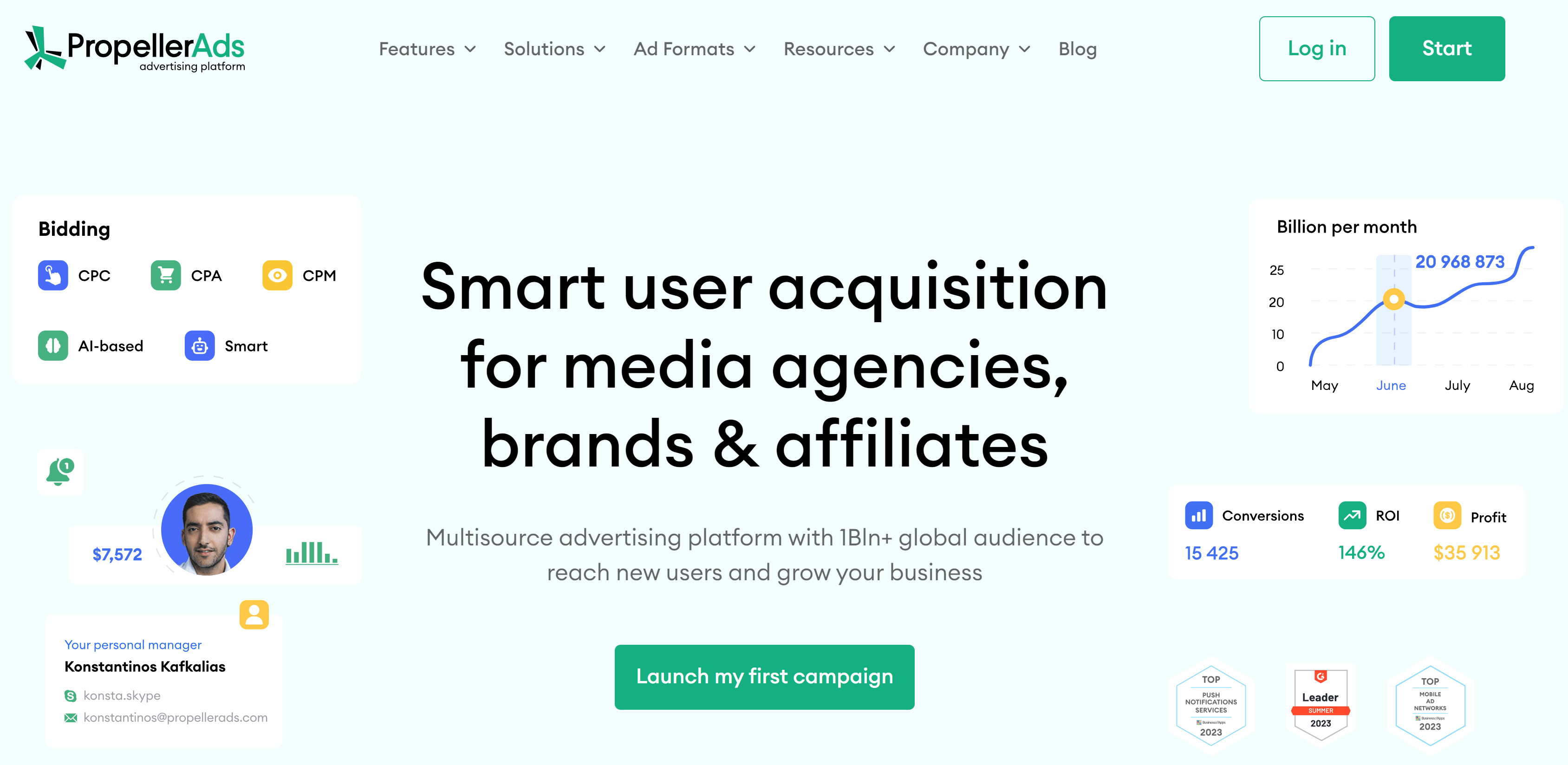
Source: PropellerAds
Increase sales and revenue
Increasing sales and revenue is, of course, the ultimate goal of eCommerce customer acquisition.
Businesses can use these platforms to increase their sales and revenue by offering promotions and discounts, such as free shipping, buy-one-get-one-free deals, or limited-time discounts, using abandoned cart recovery tactics as well as leveraging social proof.
A/B test your campaigns
A/B testing involves testing different variations of a marketing campaign to determine which one performs better in terms of engagement, conversion rates, and revenue.
A/B testing your campaigns allows businesses to improve their marketing effectiveness, optimize campaigns for maximum engagement and conversion rates, and drive more revenue.
Monitor success
Monitoring success is all about tracking and analyzing the performance of various marketing efforts and campaigns to determine what’s working and what’s not.
eCommerce customer acquisition platforms enable you to track app and site traffic, conversion rates, and other critical metrics to stay ahead of the game.
What is the best user acquisition strategy in eCommerce?
There are multiple user acquisition strategies that help to create an engaging and compelling experience for your customers and keep them coming back for more.
We’ve listed some key strategies below.
App Store Optimization (ASO)
App Store Optimization (known as ASO) is the practice of optimizing your mobile apps to rank higher in an app store’s search results.
The goal of ASO is to increase visibility and downloads for your app, thus driving more traffic and revenue to your business.
Search Engine Optimization (SEO)
Search Engine Optimization (known as SEO) is the practice of improving the quality and quantity of website traffic.
The goal of SEO is to rank higher in search engine results pages (SERPs) for relevant keywords and phrases, thereby driving more traffic to a website and increasing both its visibility and authority.
Paid advertising
Paid advertising is a marketing strategy where businesses pay to display their products or services to a specific target audience.
The goal of paid advertising is to increase brand awareness, drive website traffic, and generate leads or sales. There are several types of paid advertising, including search engine advertising, social media advertising, display advertising, and video advertising.
eCommerce customer acquisition company example
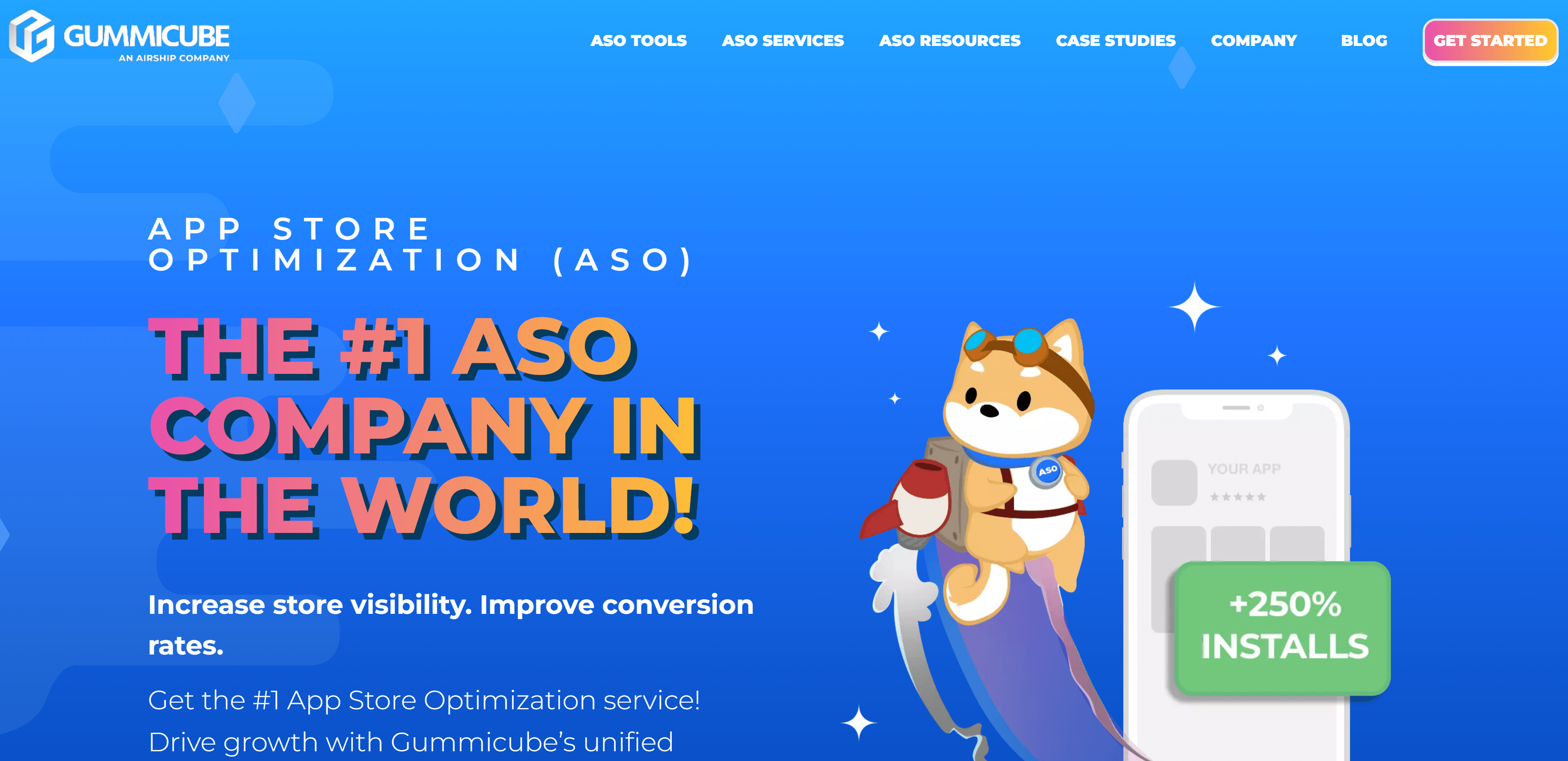
Source: Gummicube
Affiliate marketing
Affiliate marketing is a performance-based marketing strategy where businesses pay affiliates commissions for promoting their products or services.
Affiliate marketing aims to increase sales and revenue by leveraging the reach and influence of affiliates, who can promote the business through various channels such as social media, email marketing, and content marketing.
Influencer marketing
Influencer marketing is a type of marketing strategy where businesses partner with social media influencers to promote their products or services.
The goal of influencer marketing is to reach a wider audience and increase brand awareness by leveraging influencers’ large and engaged followings.
Influencers can promote a business through various channels, such as social media, blog posts, and videos.
Social media marketing
Social media marketing is a type of digital marketing strategy where businesses use social media platforms to promote their products or services and engage with their target audience.
The aim of social media marketing is to increase brand awareness, drive website traffic, and generate leads or sales.
Social media marketing can include various tactics, such as creating and sharing high-quality content, running paid social media advertising campaigns, and partnering with social media influencers.
eCommerce customer acquisition platforms – features and best practices
When it comes to eCommerce customer acquisition, there are several best practices and features that can help you attract and retain your customers.
Here are some key strategies to consider.
Personalize in-app messaging
Personalizing in-app messaging can greatly enhance the user experience and increase engagement.
Tailoring messages to each individual user’s preferences and behavior means you can provide a more relevant and compelling interaction. This not only improves user satisfaction but can also lead to increased retention and revenue for your app.
Data-driven targeting strategies
Data-driven targeting strategies involve using user data to identify and segment audiences. You can then deliver targeted messaging and content to each group.
By analyzing user behavior and demographics, you gain insights into what motivates different segments of your audience. Market research data can be used to create targeted campaigns that speak directly to each group’s unique needs.
Data-driven targeting strategies can improve the efficiency and effectiveness of your marketing efforts, leading to higher engagement, conversions, and customer lifetime value.
eCommerce customer acquisition company example
Source: Favoured
Consider customer retention
Customer retention is a critical part of any successful business strategy. Focusing on retaining existing customers can increase your customer lifetime value, reduce churn, and generate more sustainable revenue over time.
Understanding your customers’ needs and expectations is essential to improving customer retention.
Optimize product description pages
Optimizing product description pages is crucial for driving conversions and increasing sales. It’s important to understand your target audience and what motivates them so that you can create effective product descriptions.
Use clear and concise language to highlight the benefits and features of your product, and include high-quality images and videos to showcase it in action.
What is the average customer acquisition cost for eCommerce?
CAC stands for “Customer Acquisition Cost.” To calculate CAC, you need to divide the total cost of your sales and marketing efforts by the number of customers acquired during a specific period. Here’s the exact formula:
CAC = Total sales and marketing costs (TMC) / Total New Purchasers (TNP)
CAC can vary widely by industry, as different industries have different customer acquisition strategies and marketing channels–CAC is also affected by the size and competitive landscape of the industry as well as the target audience itself.
There are several other factors that can influence CAC, including:
- Technology: The type of technology you use for marketing and advertising can have a significant impact on CAC. For example, using automation tools can help streamline your sales and marketing processes, reducing the time and resources required to acquire new customers.
- Ad spend: Investing in high-quality ads and targeting strategies can help increase the effectiveness of your campaigns and reduce your overall CAC.
- Content production: By creating high-quality, engaging content that speaks directly to your target audience, you can increase the likelihood of converting leads into customers and reduce your overall CAC.
- Maintenance: The ongoing maintenance and optimization of your sales and marketing processes can also impact CAC. If you regularly review and refine your strategies, you can identify areas for improvement and optimize your campaigns for maximum effectiveness.
eCommerce customer acquisition company example
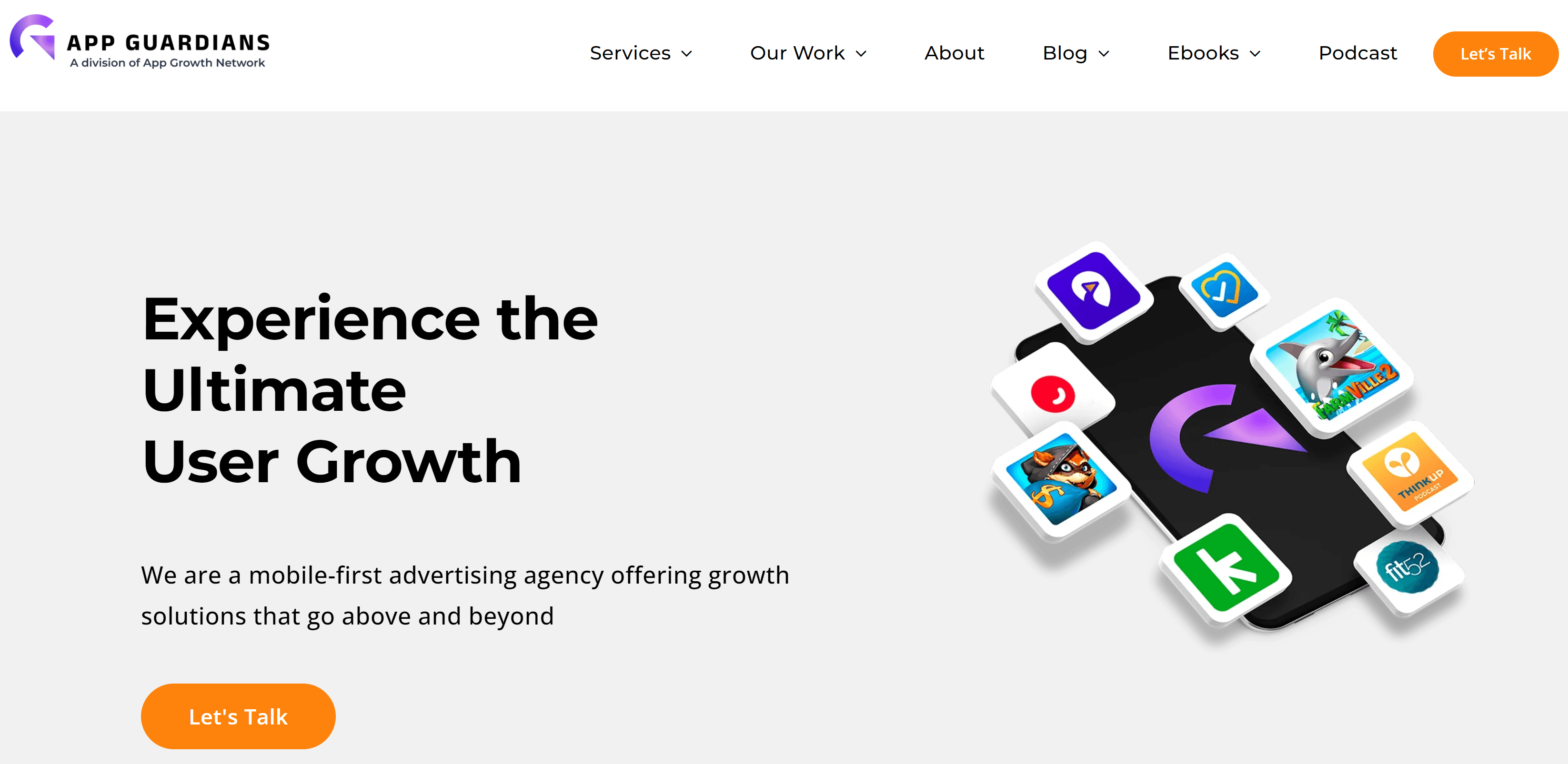
Source: App Guardians
Calculating and tracking your company’s CAC is important as this helps to identify areas for improvement and optimizes your sales and marketing efforts.
What is the best user acquisition platform for eCommerce?
The best user acquisition platform for your eCommerce business will depend on your specific goals, target audience, and budget.
Each platform has its strengths and weaknesses, so it’s vital to research and test different strategies to see which works best.
Ultimately, it’s about finding the right balance between cost and ROI while also ensuring you’re reaching the right audience.
link